
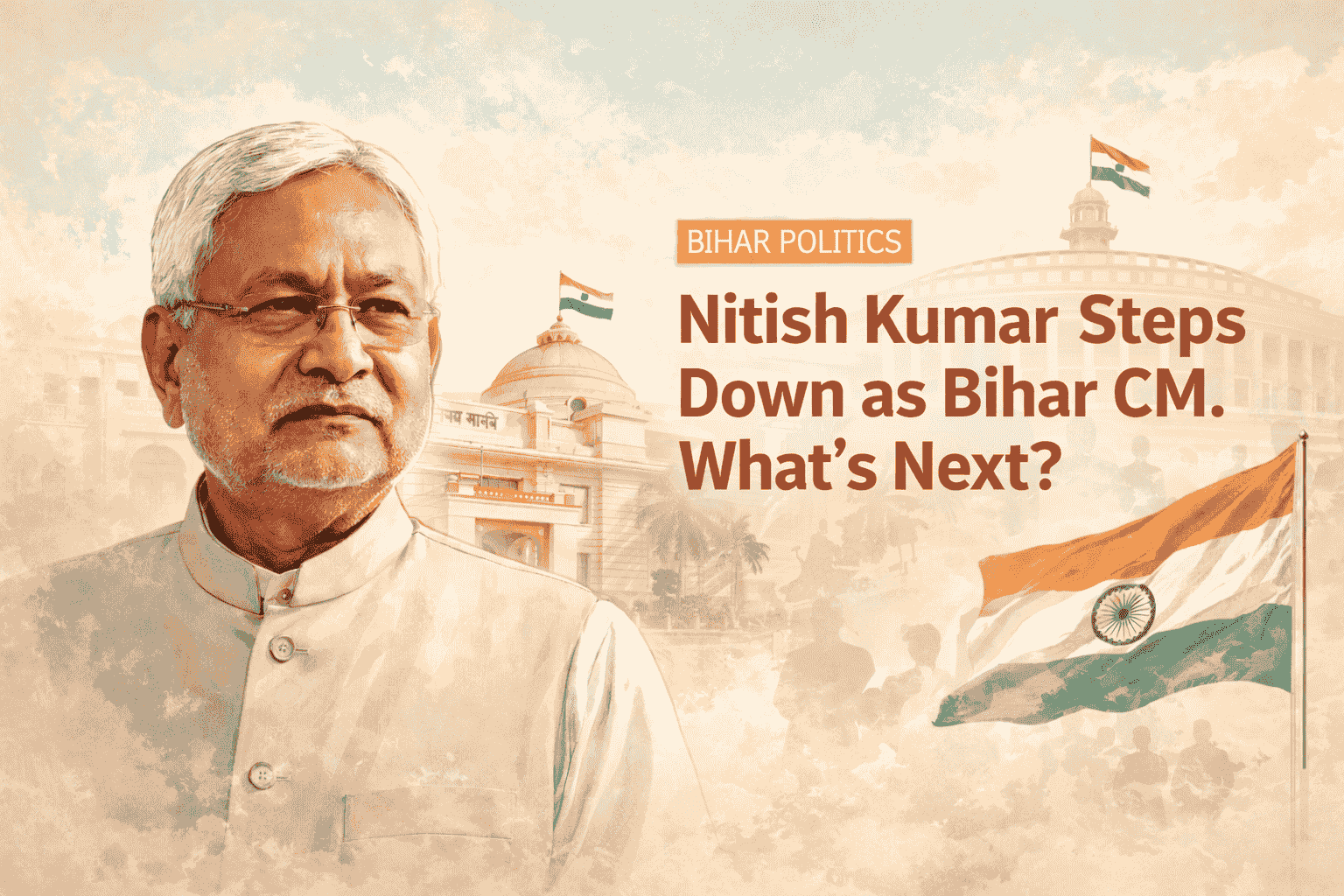
Nitish Kumar Resigns as Bihar Chief Minister
Veteran political leader Nitish Kumar has resigned from the post of Chief Minister of Bihar, marking a major turning point in the state's political landscape. The move has triggered intense discussions across political circles, with reports suggesting that the senior leader may soon take up a new role in the Rajya Sabha.
Nitish Kumar has been one of the most influential political figures in Bihar for nearly two decades. His resignation signals a significant shift not only in state politics but also in the broader political dynamics involving national alliances.
Political analysts say the decision could reshape leadership within Bihar while also strengthening strategic positions at the national level.
Background of Nitish Kumar’s Long Tenure in Bihar
Nitish Kumar has served multiple terms as Chief Minister of Bihar and is widely recognized as one of the longest-serving leaders in the state's political history.
He first became Chief Minister in 2005, leading a coalition government that promised improved governance, infrastructure development and administrative reforms.
During his tenure, several initiatives were introduced that aimed to transform Bihar’s governance and public services.
Key highlights of Nitish Kumar’s tenure include:
- Major road and infrastructure development projects
- Improved law and order initiatives
- Expansion of education programs, especially for girls
- Welfare schemes aimed at rural communities
- Focus on social justice and caste-based representation
His leadership style has often been described as pragmatic, focusing on administrative reforms while balancing complex coalition politics.
Why Nitish Kumar Decided to Step Down
The decision to resign from the Chief Minister's post has raised questions about the political strategy behind the move. While official statements emphasize internal party decisions and future responsibilities, observers believe the move may be part of a broader political calculation.
Possible reasons behind the resignation include:
- Transition to a national political role
- Strategic alliance adjustments
- Preparation for upcoming parliamentary dynamics
- Leadership restructuring within the state government
Political experts believe that the move could allow Nitish Kumar to play a larger role in national politics while enabling a new leadership structure in Bihar.
Procedure of Resignation and Constitutional Process
The process of resigning from the Chief Minister's post follows constitutional procedures defined under the Indian political system.
Nitish Kumar is expected to formally submit his resignation to the Governor of Bihar. Once accepted, the Governor may either invite another leader to form the government or ask the outgoing Chief Minister to continue in a caretaker capacity until a new government is formed.
Steps typically involved in such a transition include:
- Submission of resignation to the Governor
- Acceptance of resignation by the Governor
- Consultation with the ruling alliance
- Selection of the next Chief Minister
- Swearing-in ceremony for the new government
The process ensures continuity of governance while maintaining constitutional stability.
Nitish Kumar’s Political Journey and Party Alliances
Nitish Kumar is the leader of the Janata Dal (United), commonly known as JD(U). Over the years, his political career has seen multiple alliance shifts that have shaped Bihar’s electoral politics.
His party has formed alliances with both the Bharatiya Janata Party (BJP) and the Rashtriya Janata Dal (RJD) at different points in time.
Major political alliances involving Nitish Kumar include:
- JD(U) – BJP alliance during the NDA period
- Mahagathbandhan alliance with RJD and Congress
- Strategic coalition shifts depending on electoral dynamics
These shifts have often been viewed as strategic decisions aimed at maintaining political stability and electoral viability in Bihar.
Possible Candidates for the Next Bihar Chief Minister
With Nitish Kumar stepping down, speculation has intensified regarding the next leadership of the Bihar government.
Political discussions within alliance parties are likely to focus on selecting a leader who can maintain coalition unity while continuing governance initiatives.
Possible considerations for the next Chief Minister may include:
- Senior leaders within JD(U)
- Consensus candidates acceptable to alliance partners
- Leaders with administrative experience
- Individuals capable of managing coalition politics
The final decision will likely depend on negotiations within the ruling alliance and approval from party leadership.
Impact on Bihar’s Political Landscape
Nitish Kumar’s resignation could have significant implications for Bihar’s political future. Leadership changes often bring shifts in policy priorities, administrative approaches and alliance dynamics.
Several factors may influence the next phase of Bihar politics:
- Internal leadership changes within JD(U)
- Relationship between alliance partners
- Upcoming national and state elections
- Public perception of governance continuity
Political observers say that the transition could reshape electoral strategies in Bihar ahead of future elections.
What Role Nitish Kumar May Play in Rajya Sabha
Reports indicate that Nitish Kumar may move to the Rajya Sabha, the upper house of India’s Parliament. Such a move could allow him to participate more actively in national policy discussions.
The Rajya Sabha plays a crucial role in legislative processes, particularly in reviewing laws and representing state interests at the national level.
If he joins the Rajya Sabha, Nitish Kumar could focus on:
- National policy debates
- Federal issues affecting states
- Alliance coordination at the national level
- Strategic political negotiations
For a leader with decades of political experience, the transition could represent a shift from state-level governance to broader national influence.
Future Outlook for Bihar Politics
The resignation of Nitish Kumar as Chief Minister marks the end of an important chapter in Bihar’s political history. His leadership has shaped the state’s governance and political alliances for nearly two decades.
As Bihar prepares for a new phase of leadership, political observers will closely watch how the transition unfolds and how alliances evolve in the coming months.
The coming weeks are expected to determine the direction of Bihar’s governance and political stability.
For now, Nitish Kumar’s decision has once again demonstrated how rapidly political dynamics can shift in one of India’s most politically significant states.